
Attaching the elastic muscle cords
Each of the elastic muscle cords ("muscles") in your kit connects to two attachment sites (an origin and an insertion) and represents a line of action for a muscle. To attach the muscles, you just need to know how to attach the end of the cord to one of the three possible attachment site types: a quadriceps tendon clip, an attachment site/hole on the surface of a bone, and an attachment site/hole in a cross-section plate. And if you're attaching a muscle to a bone, you'll also need the forceps, located at the bottom left corner of Parts Plate A.
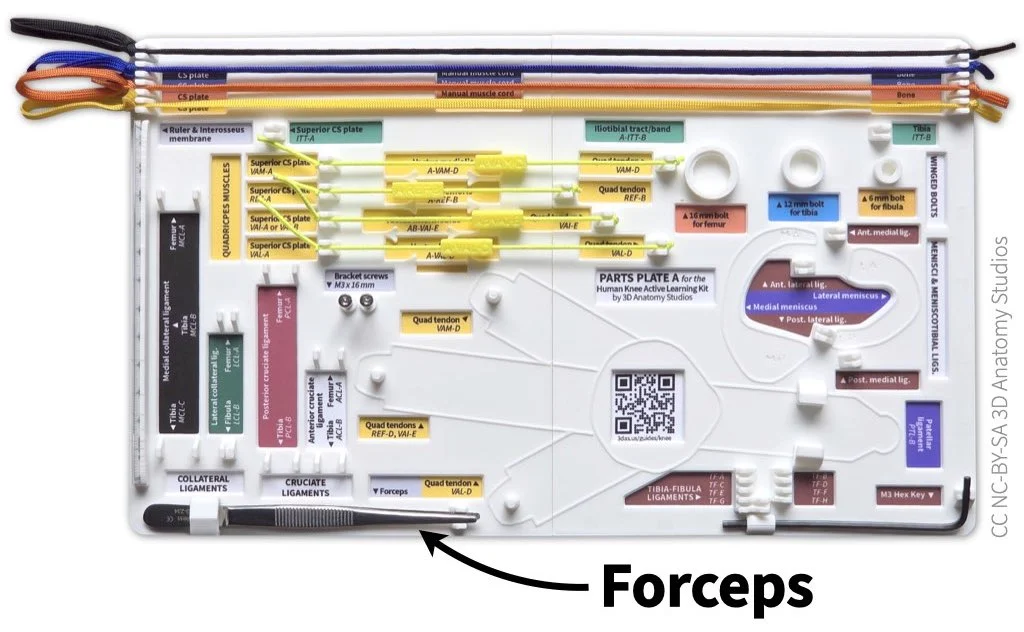
The forceps should be attached to the bottom left corner of Parts Plate A in your kit.
Before you attach any muscles, be sure that you understand the muscle color and labeling scheme used in your kit. This will help you easily identify each muscle, its attachment sites, and its corresponding compartment.
Attaching a muscle to a quadriceps tendon clip
The first muscle attachment type is to a quadriceps tendon clip. Each of the four quadriceps muscles has a yellow tendon clip, one for each of the four quadriceps tendons (wide yellow straps). These clips have attachment sites for one or up to three cords (one site for rectus femoris and up to three sites for the vasti muscles). Each clip is labeled with the corresponding quadriceps attachment site (REF-B, VAI-E, VAL-D, VAM-D). If you're attaching a muscle to one of the quadriceps tendon clips, attach it first to the clip before attaching it to the cross-section plate or to the surface of a bone.
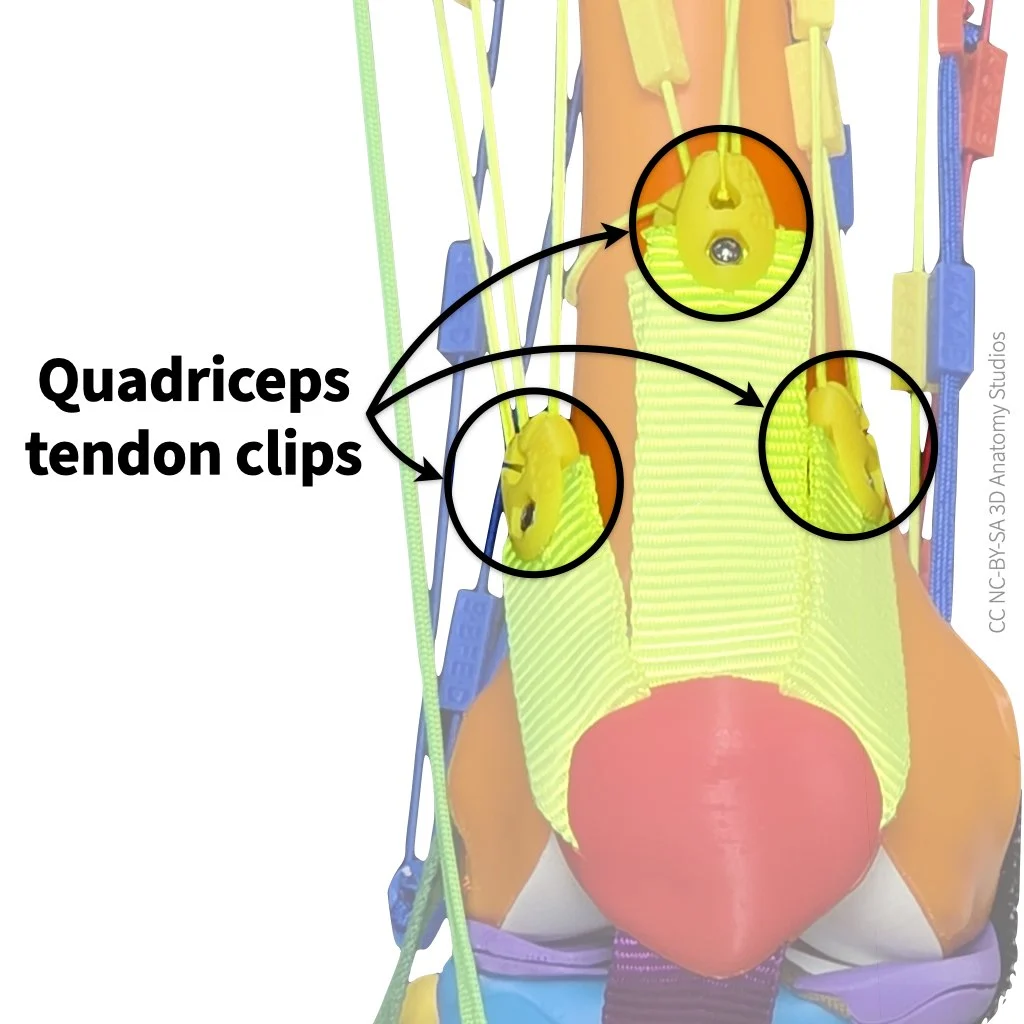
The quadriceps tendon clips (the yellow plastic pieces indicated by circles) connect the quadriceps elastic muscle cords to the quadriceps tendons (yellow straps). One of the clips (for vastus intermedius) is mostly obscured in the photo above by another clip directly anterior to it (middle clip in the photo, for rectus femoris).
To attach a muscle to a quadriceps tendon clip, insert the end of the cord with a shorter "tail" (cord after the knot) into the hole and pull the cord into the slot to lock the knot in place, as shown in the video below. When inserting the cord into the clip, be sure that you insert the cord through the labeled side first (you should see the clip label as you're inserting the cord).
Video showing how to attach an elastic muscle to a quadriceps tendon clip. The first half of the video shows steps from a front view of the clip; the second half of the video shows the same steps from a side view of the clip.
Attaching a muscle to a bone
The second attachment type is to the surface of a bone. These are the keyhole-shaped holes (with accompanying labels) that you see all over the surface of the bones of your knee kit.
Photo of an example of an attachment site on the surface of a bone with an elastic muscle cord attached, showing label printed in the surface
Inside each of these keyholes is a hook that catches the knot of a cord and holds it in place as long as the cord is pulled within the normal action range of the corresponding muscle. This means that for all of the motion simulations you perform, the cords will stay attached even though they are simply hooked into place. If you're attaching a muscle between the surface of a bone and a cross-section plate, attach it first to the bone before attaching it to the cross-section plate. If you're attaching a muscle between the surface of a bone and a quadriceps clip, attach it first to the quadriceps clip before attaching it to the bone.
To attach an elastic cord to an attachment site on a bone's surface, push the knot's cord into the hole using forceps and then pull the cord through the slit of the keyhole to pull the knot into the internal hook, as shown in the video below.
Video attaching an elastic muscle cord to a bone surface attachment site using forceps.
Attaching a muscle to a cross-section plate
The third and last attachment type is to