
What are the motion axes of the knee?
As you found in the previous step, it's challenging to observe all the ways the knee can move from observing your own knee. Your knee kit not only reproduces all of the motions of a normal knee but also allows you to observe directly how the bones are moving without needing X-ray vision. You'll use your knee kit to diagram each of the knee's four axes of motion.
On page 2 of your worksheet, you'll find a table. The three columns contain diagrams of the knee from three views: lateral, anterior, and superior. The four rows correspond to each of the four motion axes of the knee. For each of the 12 diagrams, you'll draw a projection of the corresponding axis of rotation or translation, just as you did for the cat and mouse on page 1.
Flexion-extension rotation
The most obvious axis of knee motion (the one with the greatest magnitude of motion) is flexion-extension rotation. This is one motion that you likely identified with your own knee. Flexion decreases the angle between the posterior leg and posterior thigh while extension increases this angle (recall that in anatomy, "thigh" refers to the part of the lower limb between the hip and knee and "leg" refers to the part of the lower limb between the knee and ankle).
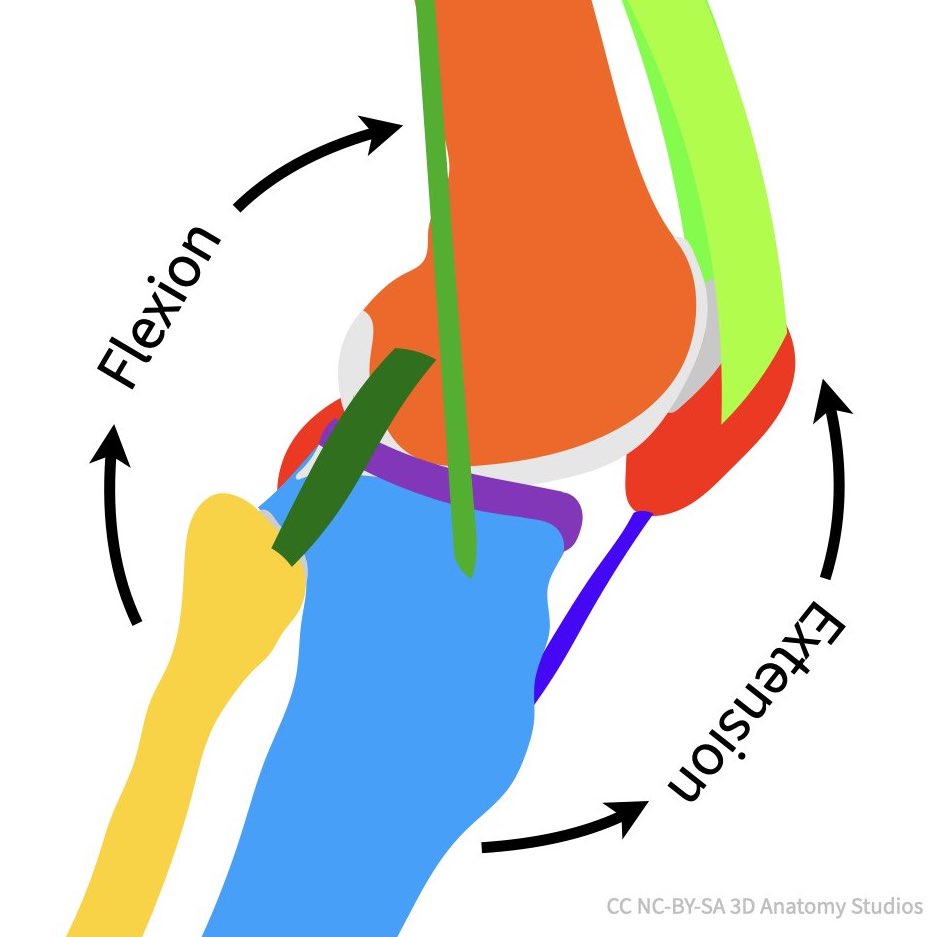
A diagram of the knee in lateral view with arrows showing the direction of flexion versus extension
Simulate flexion-extension rotation using your knee kit, using the video below as a guide and draw the axes of rotation on each of the three diagrams in the top row of your worksheet.

Your knee kit is capable of rotating the full normal range of flexion and extension though if you have both cross section plates attached (only applicable for the muscle kit versions), the plates will prevent full flexion by 10-20 degrees. Once you think you have it correct, check your answers below.
Video of flexion-extension using ligament only kit and minimal muscle kit
ASSESS
Summary